Saturday, March 10, 2012

The Last Days of the Gold Cuppers

Whenever there’s a major breakthrough in innovation in Unlimited Hydroplane racing, there are always those teams who are slow to adapt to the change.  More often than not, these slow adapters are small budget teams forced to race with outdated equipment and meet with little or no success on the water.  With this in mind, it comes as a surprise that this trend did not begin with the introduction of Allison and Rolls Royce Merlin engine powered modern hydroplanes into hydroplane racing, not right away at least.  The Gold Cuppers built years before the Unlimiteds that were on the water at the same time, more than held their own against the Unlimiteds at the time.  Although major race wins such as the Gold Cup often went to modern Unlimited Hydroplanes during this era, a boat with a “G” designation was always there and won at least one race every year but one between 1946 and 1955.
                On paper, the Unlimited Class was officially born in 1946 when the cubic inch piston limitation, along with most restrictions on the length, width, and weight of a boat, were abandoned in order to take advantage of the newly available aircraft engines from fighter planes used during World War II.  Despite the new unrestrictive rules, however, there was not a wealth of new boats using the new power sources right away.  In fact, only two boats in the 1946 Gold Cup used these modern power sources: the Miss Windsor, a Merlin powered craft that was unable to start a heat in the race, and the Miss Great Lakes, an Allison powered craft which made a strong showing for the Allison’s debut in powerboat racing.  For the first two heats, the Miss Great Lakes finished second behind the Tempo VI, then in the third heat the Great Lakes jumped out to a big lead before blowing its engine and allowing the Tempo VI to win the heat en route to a Gold Cup victory.  The Tempo VI was a boat that was definitely a representative of the sport’s pre-World War II era.  The boat was actually the former “My Sin” which had previously won the 1940 and 1941 Gold Cup races but was renamed Tempo VI after being bought by famed bandleader and inboard racing veteran Guy Lombardo.  Despite the new name and owner, the Tempo kept the same setup as it had while racing as the My Sin along with its Miller engine.  So while the Miss Great Lakes grabbed headlines with its record breaking speeds on that first national race after the end of World War II, the winner on the day was a pre-War relic and a sign that the Gold Cuppers could hold their own against modern engines.
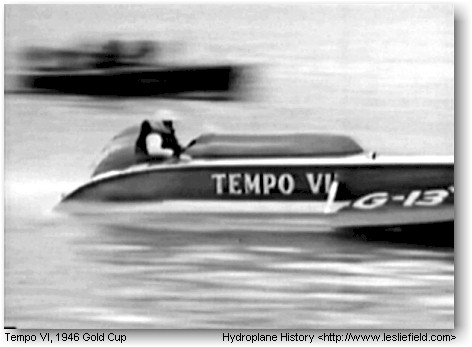
Guy Lombardo driving the Tempo VI to victory in the 1946 Gold Cup.  Photo taken from the web

                1947 saw the birth of the national tour, although Hydroplane racing was still very much a regional sport and would continue to be so for the next decade or so.  Once again, however, much of the attention and most of the trophies were grabbed by a pre-World War II boat.  The Dossin-owned entry, built in 1939 and ran previously as the So Long, underwent a major conversion previous to 1947.  The boat was converted to Allison power and changed its name to Miss Peps V.   The new name represented something else new in hydroplane racing at that time: sponsorship.  The boat became something of a representation of the transitions happening around hydroplane racing at the time, the boat being a Gold Cupper that converted to a modern power source and taking advantage of the new rules put in place for the Unlimited Class.  Carrying the Pepsi colors, the Miss Peps V won five of the seven races it entered that year, including the Gold Cup at Jamaica Bay.  Other races that year were won by the Tempo VI and the Notre Dame, meaning that seven of the nine official Unlimited races were won by pre-World War II Gold Cuppers that year.  Despite this, it should be noted that most of the boats carrying “G” designations were taking advantage of the rules of the Unlimited class and were using Allison or Merlin powerplants, so they weren’t pure “Gold Cuppers” as was understood in the pre-World War II era.  The following years would see more of these boats carrying “G” designations while using modern powerplants find more success in Unlimited Hydroplane racing.

                1948 saw the first boats to officially carry the “U” designation into Unlimited hydroplane competition.  It also was the beginning of a string of years that were unique at the top level of hydroplane racing.  From 1948 through 1953, separate championships were awarded for the Gold Cup class and the Unlimited class although they competed at races simultaneously, much in the same way that separate offshore classes will often be on the water at the same time at races in the modern era.  Three Unlimiteds (along with one pre-World War II boat carrying a U designation, the Hi Barbaree) made their debut in 1948, but only one managed to score any points that year.  The Jack Schafer owned U-1 Such Crust finished second and won the first major race for the newly-christened U-Boats, capturing the 1948 President’s Cup to go along with a second place finish in the Gold Cup that year.  The year, however, belonged to the Gold Cuppers once again.  Compared to the lone points scorer for the Unlimiteds, a fleet of twelve Gold Cuppers scored points in at least one race in 1948, including Allison powered Miss Great Lakes winning the Gold Cup after just falling short the previous two years.  This would prove to be the last Gold Cup win for a "Gold Cupper" hydroplane.  The G-13 Tempo VI won the Detroit Memorial regatta en route the overall National Championship for the season. 
A Monel Metal advertisement featuring the 1948 Gold Cup Champion the G-4 Miss Great Lakes.  Photo taken from the web.

1949 once again saw the “split” format used in awarding a Gold Cupper class champion and an Unlimited class champion, but after only one season the tide had definitely turned in favor of Unlimiteds.  Compared to the previous year when only one Unlimited managed to score championship points, ten Unlimited Hydroplanes scored points in 1949.  Most dominant among the Unlimiteds was the My Sweetie.  Piloted by the legendary Bill Cantrell, the My Sweetie won the APBA Gold Cup and five other races en route to the National Championship.  As for the Gold Cuppers, the field had dwindled to six point scorers after a string of strong seasons.  The G-boats still made their presence felt, however.  The G-60 Lahala, a New Jersey based Allison powered boat driven by Harry Lynn, won the New Jersey Governor’s Cup and the Cambridge Gold Cup, the latter being the second time the Lahala captured the race in a venue better known for rowing regattas.  Once again, however, Guy Lombardo’s Tempo VI was the class of the Gold Cupper field.  The eleven year old hull won in Baltimore and was a consistent finisher throughout the season to capture the national championship.
The G-13 Tempo VI, shown here many years later after it was preserved by H.A.R.M.  Photo taken from the web

1950 signaled the beginning of the end on a number of levels for the Gold Cuppers.  Only four G-Boats competed this year, with three of those four scoring any points.  Furthermore, this year saw the debut of the revolutionary propriding Slo-Mo-Shun IV designed by Ted Jones.  The impact this hull had on hydroplane racing cannot be overstated and has been covered by a number of hydroplane writers through the years, but for the purposes of this article the focus should be on how quickly the craft made every hydroplane built before it obsolete.  In scoring a dominant victory at the 1950 Gold Cup (which was still the only true national race at that point), the Slo-Mo-Shun IV deemed even Unlimiteds built a year or two before as obsolete, so it was no secret that the tail dragging pre-World War II hydroplanes’ days were numbered.  Despite the changing times, the Tempo VI once again had a solid season.  Guy Lombardo’s entry won four races on the year, including the National Sweepstakes Regatta and the Red Bank Gold Cup (both in Red Bank, New Jersey), the Buffalo Launch Club Regatta, and a repeat win at the Star Spangled Banner race in Baltimore.  The Canadian-American’s Freeport, New York based entry would continue to be one of the most prominent boats on East Coast races for the following years.
1951 saw an increase in Gold Cupper entries compared to previous years.  One of the best performances of the year by a G-Boat was turned in by Bill Cantrell driving Horace Dodge’s Hornet entry at the Seattle APBA Gold Cup.  The former “Why Worry” finished second in two heats and finished an overall second on the day, finishing second in the first two heats to the Slo-Mo-Shun V.  The Hornet went dead in the water during the third and final heat, but that heat was stopped after the tragic accident involving the Quicksilver which resulted in the loss of life to driver Orth Mathiot and riding mechanic Tom Whitaker, another Gold Cup boat which made its debut in 1951 but was built in a style that was more representative of the pre-World War II era.  The Hornet would go on to finish third in the President’s Cup race and finish third overall in the National High Points as well as the championship for the Gold Cup Class.  The only race won by a Gold Cupper that year was once again Guy Lombardo in the Tempo VI at the National Sweepstakes Regatta in Red Bank.
Two generations of hydroplane design competing side by side.  The G-31 Hornet is in the background and the U-37 Slo-Mo-Shun V is in the foreground.  Photo taken from the web.

Four Gold Cuppers scored points in 1952.  The Such Crust IV, a new boat from the Jack Schafer camp, won the Steel Cup in Pittsburgh with Bill Cantrell at the wheel.  At the APBA Gold Cup in Seattle, the G-2 Hurricane IV finished second in the first heat and failed to finish the last two heats, but that was good enough for an overall third in one of the strangest Gold Cup races in history that saw only one boat (overall winner Slo-Mo-Shun IV) finish the last two heats.    The Dee Jay V, a Ventor style hull on again off again competitor since its 1950 debut, had an adventurous day at the Imperial Gold Cup in New Martinsville, West Virginia.  In the first heat the G-66 Dee Jay V drove to an easy victory over the 7-litre Mercury driven by Oliver Elam after the Miss Pepsi went dead in the water.  In the second heat, the Dee Jay V caught fire but amazingly driver (and boat designer) Norman Lauterbach continued to drive a few laps until finally being flagged off the course by boat owner Daniel Murphy.  Despite being outscored by the 7-litre hydro Mercury, the Dee Jay V was awarded the “win” as account of being the only Unlimited class boat to score points on the day.  The race would prove to be the last for the colorful boat.  The G-31 Hornet-Such Crust, driven by Lou Faegol, finished first in the first heat en route to an overall second at the Detroit Silver Cup and finished all three heats in fourth place to place fourth overall at the President’s Cup Regatta in Washington, DC.  Despite these being the only two races the Hornet-Crust boat entered, it proved to be enough to capture the Gold Cup Class championship for the boat in 1952.  Of course, this was indicative of how hydroplane racing was conducted at the time.  Consider that overall High Point champion Miss Pepsi only entered five of the twelve races in 1952.

1953 saw the Gold Cuppers take home three more first place trophies.  The G-8 Short Snorter, a boat that made its debut in 1939 driven by Stan Dollar, entered only two races on the season but made them count.  First the boat won the Lake Tahoe Regatta then won the Mapes Mile High Gold Cup, also held on Lake Tahoe.  The Tempo VI returned to competition and was once again a winner in Red Bank, capturing the Red Bank Gold Cup.  The G-22 Such Crust III, another Jack Schafer entry driven by Chuck Thompson, was the only G-Boat to enter the Gold Cup that year and finished an overall third.  The Such Crust III went on to finish second in the Silver Cup in Detroit and the President’s Cup in Washington, DC to win the Gold Cup class championship.  This would prove to be the third straight year when the Gold Cupper championship was won by a boat that did not win a race on the year (despite the fact that multiple races were won by other G-Boats all three of those years), and it would also be the last year that the APBA would award a separate championship for the Gold Cup class.  With the Unlimited sport inching toward becoming a more professional endeavor and the loss of their championship; it was only a matter of time before the Gold Cuppers, more representative of the amateur past of the sport, would be a thing of the past.  Despite the slowly dwindling number of G-Boats, a few entries would soldier on for the next few years.
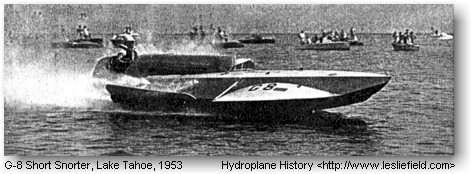
The G-8 Short Snorter en route to victory in the 1953 Mapes Mile High Gold Cup.  Photo taken from the web.

Seventeen boats scored points in 1954, but only two of those boats carried the old “G” designation.   The Short Snorter once again entered the two Lake Tahoe races, but this time had to settle for second and third place finishes.  Also competing in the Mapes-Mile High Gold Cup was the Hurricane IV, who finished second in the only race it qualified for that year.  For the first time in post-World War II racing, no Gold Cupper boat won a top level hydroplane race and no Gold Cupper competed in the APBA Gold Cup.
After the cancellation of the Gold Cup class championship in 1953 and the G-Boats failed to make much of a showing in 1954, it perhaps looked as if the Gold Cuppers were dead.  In 1955, however a new G-Boat debuted and had perhaps the best season ever by a Gold Cupper in the modern era.  Not surprisingly, it was the owner and the team that was the most successful G-Boat over the past decade.  Guy Lombardo came out of semi-retirement in 1955 and debuted a new hull, the G-13 Tempo VII.  The boat was still built within the pre-World War II specifications to qualify as a “G” boat although it did use Allison power.  After an inauspicious beginning where the boat only entered two of the season’s first five races, one of which was the Gold Cup race in Detroit where the boat failed to finish a heat and saw driver Danny Foster suffer injuries, the boat went on one of the most memorable streaks of the 1950’s.  Danny Foster returned to the cockpit and went on a tear where the boat won five consecutive races it entered: The Copper Cup in Molson, Montana, the Silver Cup in Detroit, the President’s Cup in Washington, DC, and the Governor’s Cup in Madison which would give the Tempo VII the distinction of winning the most races in 1955.  The President’s Cup Regatta, then considered second in prestige only to the Gold Cup, saw the Tempo VII make an incredible come from behind victory.  Going into the Final Heat the Tempo VII was fourth in points and 231 points behind the Miss Pepsi that had won its previous two heats.  In the third and final heat, however, everything went the Tempo’s way as the Miss Pepsi went dead in the water and the Tempo VII went on to victory and the right to meet President Dwight Eisenhower.  After winning in Elizabeth City, the Tempo VII won the Governor’s Cup in Madison, which at that time was in only its second year as a National Unlimited Hydroplane tour race but became a representation of the changing times: this would prove to be the last victory in the Unlimited Class for a boat carrying a “G” designation.  Despite the Tempo’s incredible run, its late start probably prevented any chance of the boat capturing the National High Point championship for 1955 and Lombardo, Foster, and the Tempo VII team had to settle for second in the High Points behind the U-55 Gale V.  It should be noted however, that the Tempo VII finished ahead of the Gale V on a routine basis in 1955 and the Gale V entered and finished on the podium in all five races that the Tempo VII won.  Despite its late start, Lombardo’s Tempo VII was definitely the boat to beat in 1955. 

Almost to prove that the Tempo VII’s success wasn’t a fluke, another Gold Cupper, the G-22 Such Crust III also had a stellar season in 1955 and won the St. Clair International Boundary race.

Unfortunately, neither the Tempo VII nor the Such Crust III was able to repeat their success in 1956.  The Tempo VII entered the season opening Maple Leaf Trophy race in Windsor, Ontario, but sustained damage and was unable to start a heat.  The only other race it entered was the season’s penultimate race: the Governor’s Cup in Madison where the boat finished fourth.  The Such Crust III found itself plagued with mechanical difficulties throughout the season and saw its best finish as a third place (in a field of four) at the St. Clair International Boundary race.  The hydroplane racing world around them was also changing.  By 1956, many of the top flight teams were converting from Allison engines to the more powerful Rolls Royce Merlin engines and within a few years it became no secret that a team would need a Merlin engine if it expected any type of long term success (although a handful of teams used Allison power throughout the thunderboat era of Unlimited racing).  The Gold Cup boats, already considered by many to be too small to carry an Allison engine, was way too small to handle the horsepower of the Merlin and an already dying design option became completely obsolete.  Also, the sport was becoming more professional with the formation of the Unlimited Racing Commission in 1957.  The Gold Cuppers, more representative of the sport’s amateur days of being an expensive and adventurous hobby for those who had the means and the will to throw a lot of money around, found themselves as a square peg in the round hull of the newly professionalized Unlimited sport.  So when the Unlimited Racing Commission had its first season in 1957, the Gold Cuppers were left in the past.  A decade after the new relaxed rules and the creation of the Unlimited class planned their obsolescence, the Gold Cuppers were finally no more.  It should be noted, however, that the two remaining G-Boats did compete for a few more years as U-Boats.  The Such Crust III continued for three years under the same name as the U-60 and the Tempo VII was sold, the name changed to the U-99 Miss Detroit, and had a couple of stellar seasons topped off by a 1960 President’s Cup victory.
After 1956, the G designation was no more in the Unlimited Class.  Every now and then over the last few decades there is talk of recreating the “G” Class as a step down from the Unlimiteds on the hydroplane ladder or perhaps as a substitute for the Unlimiteds by some ambitious souls.  Most notably, during the back and forth between the two competing Unlimited sanctioning bodies in 2004, both the Hydro-Prop and the Unlimited Lights (who had sanctioned the “outlaw” Unlimited races that year) leadership claimed to have tentative plans of creating a G Class.  Currently there are a handful of boats carrying this designation, but they are a few and the sanctioning North American Challenge Cup Series has never really gotten off the ground.  It has been more than a half a century now since the last time a G-boat competed alongside the Unlimiteds, and really their story has never been told.  It was not uncommon for over twenty Unlimiteds to compete over the course of the season in the late 1950’s and early 1960’s, so the loss of a couple boats built to obsolete specifications was hardly remised during this era.  The accomplishments of the boats owned by Guy Lombardo, Jack Schafer, and the other G-Boats, however, show that even when facing the new innovative boats these smaller hulls could still compete and grab its share of victories.

My thanks to Jim Sharkey’s “Hydros Who’s Who,” Leslie Field’s Hydroplane History website, and various articles by Fred Farley available through the Hydroplane and Raceboat Museum for the information provided for this post.

Sunday, February 19, 2012

Looking Ahead to the H1 Meetings: Some Rule Changes I'd Like to See

It's hard to believe, but we're less than a week away from the annual H1 Meetings & Banquet. If you haven't read the official release yet you can go here:

http://www.h1unlimited.com/2011/12/h1-meetings-banquet-set-for-seattle-westin/

There are always plenty of interesting developments coming out of the meetings, ranging from rule changes to new teams to new sponsors or race sites.  I'm not sure what to expect out of this year's meetings, but no doubt it will be something worth commenting on here once the meetings are concluded.  Compared to recent years, the annual "silly season" in the hydroplane world has been relatively quiet this year with the obvious exception of the news that Ted Porter is leaving the sport.  While what will happen to the equipment of Precision Performance Engineering is left to be seen, much of the anticipation around this year's meetings circles around the possibility of last year's exhibitions in Sacramento and Washington, D.C. growing into full races for the 2012 season.  For this post, however, I'm going to focus on rule changes I'd like to see.  First off, I should make it a point that I don't anticipate all or even any of these rules to be employed in this year's meetings.  These are merely things that I, as a fan, would improve the overall quality of an  already great sport.  So without further adieu here are some rule changes I'd like to see, broken down by category:

Specs


Lower the minimum weight for an Unlimited:  This is something I wanted for a long time.  The minimum wet weight is, in my opinion, set much too high at 6,500 pounds.  I have a few reasons for believing this.  First off, when compared to other hydroplane classes the Unlimited's already high minimum weight looks astronomical.  Consider that the Unlimited Light and Grand Prix classes, which are the step below Unlimiteds on the hydroplane ladder, both have a minimum weight of 2,700 pounds.  So an Unlimited Hydroplane is quite literally more than twice as heavy as a hydroplane in any other class.  Another reason is that when a new Unlimited is built one will almost inevitably hear of how they needed to add extra weight to the boat in order to meet the minimum weight requirement.  Now, I'm guessing this would be the case no matter how low the minimum weight is set (there are, after all, very skilled people working on the Unlimiteds) but the fact that they are forced to sometimes add hundreds of pounds of weight to a boat shows that the technology and design is there to race at much lower weights.  So let's put all the Unlimiteds on a diet and lower the minimum weight by a few hundred pounds.

Allow more development with turbine engines With the competitive results over the last twenty years and the way the rules are written now, the Unlimiteds are pretty much limited to racing with one type of turbine engine.  Although the rule book is left wide open for automotive engines (no doubt as a means to encourage development) nearly every team has gone the turbine route over the last two decades.  Historically, the Unlimited class has been one of research and development, a place where new ideas are tried out in a competitive setting.  Many of these ideas fail, but there have also been a number of breakthrough innovations to come from the Unlimited class due to this tradition .  Innovation still rules the day in Unlimited Hydroplane racing, but the combination of restrictive rules on engines and competitive results while using these restricted engines means that for nearly twenty years now every team except Ed Cooper's U-3 team has been limited to a Lycoming T-55 L7C engine.  Now, just to clarify I'm not advocating getting rid of fuel restrictions or N2 restrictions, which are necessary for the sustainability of these engines, but instead I'm advocating for the rules to allow teams to use turbine engines other than the Lycoming T-55.  The rules should be relaxed in order to allow teams to experiment with other turbine engines and different setups for said engine.  With the right ingenuity, a team could develop the next go to engine for the sport.

Curbing the competitive advantage of the "thin prop" Speaking of innovations, the biggest development spec-wise in the sport over the last decade or so has no doubt been the use of thinner and thinner propellers.  Sure, its importance is sometimes overstated  (and the accusations that some of the bigger budget teams use a prop for one heat then throws it away are down right ludicrous) but no doubt thin props have been at the forefront of innovation in recent years.  At the same time, however, it has also represented a gap between the haves and the have nots in the sport.  While some teams could use the more brittle thin props knowing they have spare propellers in case it breaks or is unusable for future heats, other teams are forced to go with more sturdy props, as they usually do not have the luxury of burning through multiple propellers that can cost in excess of $10,000.  One proposal I've read  which makes a lot of sense is instituting a minimum weight for propellers, which would effectively ban the thin prop.  Another rule which I think might be worth a try is something similar to NASCAR's one engine per race weekend rule, only instead of engines, make it so that a team has to use the same propeller through the weekend.  If a team changes a prop due to damage or any other reason during the weekend, make it so they have to start from the outside lane for the rest of the weekend (similar to how a NASCAR team starts at the back of the field if they change engines during the weekend).  I'm not sure if such a rule would be viable in Unlimited Hydroplane racing, but I think it's at least worth looking into.

On the shore


Implement the Hughes Plan at all races Something that was tried at Madison for a few years (as well as Nashville for its lone event in 2005) was something known as the Hughes Plan.  Named after Miss Madison owner rep Bob Hughes who came up with the idea, the way it worked was that boats were assigned to heats based on their spot on the qualification ladder.  The intention was to take the randomness of the heat draw and make it so every boat faced every other boat at least once in heat competition.  Although it didn't gain wide acceptance, personally I would like to see this used for all races.  With how tight the competition is on the water now, the Hughes plan is a perfect way of  ensuring that all the top teams will face each other at least once in the prelims.  Likewise it also ensures that no teams will be able to take a backdoor way into the Final Heat by getting easy heat draws throughout the prelims.  Most importantly in my opinion, however, is that the Hughes plan takes away any possibility of the High Point championship being influenced in any way by the drawing of ping pong balls.  The Hughes plan does have some criticisms, one which holds some merit is that if a boat withdraws then that boat's heats will have one less boat in its already determined heat draws.  I would say though that that one demerit is not enough to toss out heat assignments in favor of deciding participants by drawing ping pong balls out of a bucket.

On the Water


Starting Procedure Seemingly every possible starting procedure has been used in Unlimited racing throughout the years, ranging from clock starts to flag starts to fighting for lanes to assigning lanes by seemingly every method thinkable to off plane rules to score up buoys.  I'll start off by saying that I prefer fighting for lanes, and I think the majority of fans prefer this.  Also, although many fans groan about it, I've never had a huge issue with the "crawling starts" with boats slowing down, sometimes for minutes at a time, in order to hold the lane they want behind the starting line or score up buoy.  To me this is all part of the strategy of hydroplane racing, just like leapfrogging a slow boat is also part of the strategy.  I have to say, of all the starting procedures that Unlimited hydroplane racing has used throughout the years, my favorite just might be the one that was used for the first four races this season.  With its four checkpoints (crossing the starting line at speed during the milling period, the one minute score up buoy at the exit pin of the first turn, the lane commitment buoy at the entrance pin of the second  turn, and of course the starting line as time expired) gave drivers no shortage of things to do before the race began and in turn gave the fans no shortage of things to watch.  I realize the trolling behind the score up buoy received  lot of criticism but as I said above it is all part of the strategy and as Steve David showed in Seattle this year it's a strategy that's susceptible to an outside boat willing to take a chance and leapfrog the field.
So while I loved the starting procedure used in the first four races, I was in no way a fan of what was used for the last two races of basing lane choice based on the order in which boats were drawn.  I wouldn't call it my least favorite starting procedure ever used (nothing is as bad as the flag start) I felt it was a way of cheapening the results and taking the race out of the drivers' hands.  Sure, there were complaints about the starting procedure, but I felt what was put in its place was an overreaction and there's no reason that they couldn't have gone back to the lane assignment format that was used in 2009 and 2010.
So it's left to be seen what starting procedure will be approved for 2012.  First off, I think it goes without saying that the sport should have one starting procedure for all races and not have freshwater rules and saltwater rules.  I would hope that fighting for lanes returns in some form, but if we must have lane assignments then the format used in 2009 and 2010 of inverting the order for the second set of heats while giving lane choice to the highest in points for the other heats worked well.  I don't think that minimum speed or off plane rules, which have been proposed or implemented, will not work because it leaves too much to judgment (how long was the boat below the normal speed? was the boat going off plane caused by another boat? if so who is penalized?).  At the end of the day, perhaps it wouldn't be the worst idea to turn back the clock to the time before score up buoys or off plane rules and just make it a free for all fight for lanes.

Make all heats 5 laps Doesn't really need much explanation.   Extending the length of preliminary heats has been toyed with in the past and should be something that's made full term.  Three laps for prelims just seems too short, and for whatever reason five laps for any hydroplane heat just seems to work out nicely.  Just to be clear, I don't want to make the Final Heat any longer, but instead making all heats five laps.

Double the points awarded for the Final Heat Something that's always kind of stuck in my craw is the fact that the same amount of points is awarded for the Final Heat as they are for the preliminary heats.  To understand why this is one has to look at how the format for Unlimited races has evolved over the years: Three heats involving all boats entered with the winner being the boat that scored the most points in all heats, two split heats and a Final with the winner being the boat that scored the most points in all heats, two split heats and a Final with the winner being the winner of the Final Heat, to our current format of three split heats and a Final with the winner being the winner of the Final Heat.  So while the race format has evolved over time, the format for awarding points is still a relic of the time when all three heats were of equal importance.  First off, I love the APBA's format of points descending in three fourths intervals so I don't want to change anything there.  So with that in mind I think the best choice is to double the points for the Final Heat (800 for first, 600 for second, 450 for third, etc.).  It goes without saying that the Final Heat is the most important heat of the day and the one in which most fans and people involved with the sport judge the race and one's importance, so the points should reflect this.

So there is my list of rule changes or modifications I'd like to see.  I welcome your comments or anything you might want to change yourself.  I doubt that any of these will be implemented for 2012 (the only major rule alteration I expect for 2012 is a clarification on the starting procedure) but maybe some of these will be considered down the road. Unlimited Hydroplane racing is a fantastic form of motorsports that continues to head in the right direction under the leadership of H1 Unlimited, but as the old saying goes, there is always room for improvement.

Friday, January 13, 2012

It takes two (or three): Leland Unlimited, 1992-2002

For this post I’ll be concentrating on the Leland Unlimited team.  Instead of writing a comprehensive history, however, this post will concentrate on one decade of the team’s long involvement in Unlimited Hydroplane racing.  It was no doubt the most successful decade in the history of the team, made even more emphatic by the fact that it is sandwiched in between two eras in which the team was a consistent competitor but was by no means a frontrunner.  Also during this era Fred Leland embarked on an unprecedented pace of boat construction and would often bring multiple hulls to a race site.  Despite facing better financed teams with better known sponsor throughout this era, Leland Unlimited often found itself at the front of the pack due to shear ingenuity and some of the most skilled crew members and drivers of that time.
Since his debut as a driver in 1976, Fred Leland has essentially been a regular figure around Unlimited Hydroplane racing over the last five decades.  His driving career spanned nine years but was largely unremarkable, mostly having to make do with small budget teams using outdated equipment.  Leland became an owner in the 1980’s but the team was still an also ran, usually only making appearances in the west coast races.  Usually racing as the Miss Rock as a nod to the radio station that sponsored the team, Leland’s hydroplanes were noteworthy for being one of only a handful of boats in Unlimited history to use a Packard engine.  As with most piston teams of that era, however, Leland’s operation was largely an underfunded also ran on the Unlimited tour.
In 1992 the groundwork was laid for all of this to change.  Leland Unlimited joined the modern era by breaking out a new turbine powered hydroplane as well as racing the full national tour.   It also marked the Unlimited debut of Nate Brown, who also doubled as the team’s Crew Chief.   Despite racing a national tour, the team kept its distinctive U-99.9 number as a nod to the radio station that sponsored the team for the Washington races.  After a shaky start where the team missed the season opener in Miami, failed to score any points in Detroit, and struggled to get up to speed in Evansville and Madison, the Leland team rebounded to have a solid west coast swing, qualifying for the Final Heat in Tri-Cities and even finishing on the podium in Seattle and San Diego.  The performance was good enough to earn Nate Brown Rookie of the Year honors.  Despite early struggles, the late season swing gave a glimpse of what the Leland team could achieve with turbine power.
1993 brought more changes.  Nate Brown parted ways with the team to join Bill Wurster’s Tide team as a crew member and took over for driving duties for the U-8 when primary driver George Wood Jr. was injured in an accident in Kansas City.  In his absence Mark Evans joined the team as driver.  To make matters confusing the Leland team adopted the name American Spirit, which was the same name used by Mark Evans’ previous ride owned by Ron Jones.  As is usually the case, Mark Evans got the most out of the equipment underneath him, qualifying for the Final Heat at nearly every event in 1993 and scoring a second at Evansville and a third in Seattle.  The American Spirit also had a shot to win in San Diego but saltwater caught the engine and the boat scored a DNF in one of the wildest Final Heats in Unlimited Hydroplane history.  Overall the team finished a respectable sixth in the High Point standings.  Although the U-100 American Spirit used the hull that Leland Unlimited debuted in 1992, the team introduced another hull in the midseason that raced as the U-99.9 under various names.  This was the beginning of a time of impressive participation (as well as the inspiration for the name of this post) by the Leland Unlimited team.  In an era when many of the bigger budget teams would bring multiple boats into the pits but only enter one boat into competition, Fred Leland would bring multiple boats into the pits and race all of them.  The debut of Leland’s second team might be one they would rather forget, however.  In the boat’s maiden race in Madison, the boat didn’t get into the water until the provisional Heat and then only did one warm up lap before coming back to the pits.  This set the tone for a season that saw the U-99.9 only score points in Tri-Cities and Honolulu and wound up flipping in Seattle.
In 1994 two names joined Leland Unlimited that would bring the team unheralded success.  Detroit based Progressive Tool & Industries Company came aboard as primary sponsor, alas bringing the usually small budget team a national sponsorship.  To drive the Pico American Dream (as the boat would be known) Leland turned to Dave Villwock, who like Mark Evans before him had previously driven for Ron Jones Jr. racing.  Villwock at that time had only driven portions of two seasons but in his still budding career he had experienced the highest of highs in winning his debut race in San Diego in 1992 as well as the lowest of lows in experiencing horrific blowovers in Detroit and Tri-Cities in 1993, the first flip causing Ron Jones Jr.s’ innovative new hull to be shelved for the season and the second flip leading to Circus Circus pulling out as a sponsor.   Another change for 1994 was the U-100 and the U-99.9 switched boats for 1994, each using the boat that the previous team did in 1993.  For the first of the season, the U-100 team struggled with its highest eastern finish being a sixth place in Detroit and failing to score any points in Evansville.  It was in Evansville where the U-99.9, driven by colorful Limited veteran Jack Barrie, scored a surprise third place finish.  As the tour shifted west, the fortunes of the U-100 shifted dramatically.  In Seattle, Dave Villwock and the Pico boat took advantage of some misfortune for the Miss Budweiser and the Smokin’ Joe’s teams then held off a late charge by Mark Evans in the Miss Exide to score the victory for the Pico American Dream.  After being involved in the sport for eighteen years, Fred Leland had his first win.  

Then, as if to prove that they were for real, Villwock and the Pico American dream repeated in the next race in San Diego.  This time the boat beat the Miss Budweiser head to head and with Hanauer holding the inside lane, something unheard of during that period of Unlimited racing.  

The U-100 finished the season with a fourth place finish in Honolulu to finish fifth in the High Point standings.  The U-99.9 struggled through much of 1994 after its surprise third place in Evansville and skipped the San Diego and Honolulu races.
1995 brought no victories for Leland Unlimited but the team had an overall more consistent season.  Dave Villwock finished on the podium in six of ten races in the Pico American Dream including seconds in Detroit, Evansville, and Madison.  The U-99.9 finished on the podium in five of ten races with a second in San Diego.  The U-99.9 was driven primarily by Mark Evans that year although Jimmy King filled in for the two Indiana races as Mark Evans briefly left to drive the Miss Budweiser.  Perhaps most impressively, the team finished two-three at Detroit and Madison.  Despite this success it was largely in the shadows, as 1995 proved to be the culmination of the intense rivalry between the Miss Budweiser and Smokin’ Joe’s teams who swept all of the race victories that season and went into the Final Heat of the final race of the season with the High Point title still in doubt.  So while much of the attention went to the top two teams in the sport that year, the U-100 and U-99.9 finished third and fourth respectively in the High Points that year.  The groundwork was laid for the team to make the big jump.
Coming into the 1996 season, much of the anticipation of the fans and media was once again expecting a head to head yearlong battle between Chip Hanauer and the Miss Budweiser and Mark Tate and the Smokin’ Joe’s.  The first race of the year, which instituted a tournament style match race format on Firebird Lake outside of Phoenix, seemed specifically designed to open the season with the excitement of a matchup between these two juggernauts.  As the event unfolded, however, a funny thing happened on the way to the showdown in the desert.  Dave Villwock defeated Mark Tate in the semifinal, then took advantage of a mistake by Chip Hanauer  in the final match race (he hit a buoy in the warmup period, effectively ending the race before it even started) to capture the win in Phoenix.
Phoenix would merely be a prelude, however, for what would happen the next race in the Gold Cup.  The Detroit River course was rough even by its own standards over that weekend.  On the last heat of Saturday action the two boats who had received the lion’s share of attention up until that point in the 1990’s were involved in a horrific accident.  The Miss Budweiser and Smokin’ Joe’s collided, with both boats suffering considerable damage.  

The next day the Leland team was in the spotlight.  Mark Evans, which had started that season driving Leland’s U-99.9, transferred to the Miss Budweiser team and finished second in the Final Heat that weekend in a repaired boat.  Evans’ second place was well behind his now ex-teammate, however.  Villwock had driven the Pico American dream to the first Gold Cup for the Leland team and for himself as a driver.  

In retrospect, the 1996 Gold Cup race was the turning point of the 1990’s for hydroplane racing.  The two drivers who were so dominant up until that point in the decade saw the trajectory of their careers change after their collision.  Chip Hanauer would never again drive the Miss Budweiser and would stay out of the sport completely for nearly three full seasons.  Mark Tate would only win three more races, none after the untimely passing of owner Steve Woomer following the 1997 season.  In their stead came into Dave Villwock, who would go on to have one of the most dominant and most impressive five year runs the sport would ever see.  None of this could be known at the time of course and for the Leland team they were just enjoying the thrill of winning the first two races of the season and looking for what the rest of the season had to bring.
As it turned out, 1996 would be an amazing ride for Fred Leland, Dave Villwock, Crew Chief Dan Walters, and everyone involved with the Pico American Dream team.  The U-100 would finish second in Kansas City, win again in Evansville, and finish third in Madison to close out the eastern tour with a considerable lead in the High Point standings.  Their lead only expanded on the tour’s Pacific Northwest swing as Villwock and the U-100 would win in Tri-Cities, Seattle, and a return event for that year in Kelowna, British Columbia.  Heading into San Diego, the team only needed a few points to clinch the championship on the year, and did just that despite not being able to make it to the Final Heat.  It had happened, the underfunded but highly talented team had put it all together for one year and captured the elusive High Point title.
The other Leland entries had a respectable although ever changing season.  The U-99’s driver’s seat became part of a game of musical chairs.  After Mark Evans left for the Miss Budweiser team, Mike Eacrett was tabbed to drive the U-99 (although Jimmy King was initially announced and listed in the 1996 Madison Regatta program as the U-99 driver).  At Madison Eacrett, who had suffered a horrific flip in his own boat the previous year, gave up the seat citing his ribs which steal needed healing.  In his place, regular U-3 driver Mitch Evans took his seat for the Final Heat in Madison.  In Tri-Cities veteran driver Larry Lauterbach was tabbed as U-99 driver who teamed with another Leland hull, the U-98 driven by Scott Pierce.  As the boats left Washington, Scott Pierce took over driving the U-99 for San Diego and Honolulu.  Despite the seemingly unending revolving door, the U-99 and U-98 teams had a respectable year in 1996, collecting four fourth place finishes along the way.  Although the focus for the Leland team in 1996 was clearly on the U-100 camp, the “sidekicks” to the Pico American Dream had a season that was respectable season in their own right.  Also in 1996 the Leland team did something all but unprecedented in Unlimited racing when they built and simultaneously raced two brand new hulls that season.  Although the Pay N Pak team also debuted two newly built hulls in 1969 the two boats never raced simultaneously and one was effectively a replacement for the other (the first was the experimental “outrigger” hull that failed as a competitor and was retired).  Not only was Fred Leland’s shop building new boats at a rapid pace, other Unlimited shops were looking to copy the low profile wide sponson Leland style with their hulls as well.  The Leland team was at the pinnacle of the sport and at the forefront of hydroplane innovation, and the 1996 championship was the ultimate proof of that.
The excitement of the championship was short lived, however.  Before the boats had made their way to the season finale in Honolulu, there was already talk of Dave Villwock leaving the Leland team to take over driving duties of the Miss Budweiser.  Those rumors were confirmed with an announcement by Bernie Little after the Final Heat in Honolulu.  The boats hadn’t even left the pits of the 1996 season finale and the man behind much of the success of the 1996 championship had switched teams. 

  Upon Villwock’s departure, Mark Evans returned to Leland Unlimited to drive the Pico American Dream.  The U-99 once again planned to race the full season, and this time Leland tabbed 1996 co-rookie of the year Mark Weber as the team’s driver.  In the garage things around the Leland shop were as busy as ever.  Another new hull debuted in 1997 although it was relegated to the role of backup hull almost from the beginning, but the true excitement was around some experimental concepts coming from the Leland camp.  The 1997 UHRA season preview magazine mentions a hull the team was planning that would actually seat the driver within the left sponson.  Although this boat was never built, it shows the experimenting nature around the team at the time and I’m sure the concept drafts of the hull were a sight to see (if anyone has seen these drafts, let me know).
 The Eastern tour was a struggle for the team as a whole.  The Pico team, despite finishing third in Phoenix and second in Evansville, was hampered by back to back Final Heat DNF’s at Madison and Norfolk and was a considerable distance behind Dave Villwock and the Miss Budweiser, who had swept the Eastern races, in the High Point standings.  Mark Weber, still getting his feet wet in the Unlimited class, showed some flashes of brilliance, especially in Madison where he finished third overall.  In Tri-Cities the season made a dramatic turn.  Dave Villwock was involved in a horrific accident in the first run of the Final Heat where he had to be revived after being pulled from the boat, badly damaging the T-5 and causing Villwock to miss the rest of the season due to the injuries sustained.  Mark Evans would win the Final Heat rerun and suddenly the Leland team was once again the team to beat. 

  For the second straight year, Bernie Little would turn to the driver of the U-99 to fill in for his injured driver and Mark Weber left the Leland team to drive the Miss Budweiser.  Without a driver, the U-99 would miss the following race in Kelowna, but Mark Evans would drive the U-1 Pico American Dream to victory for the second straight week. 
The 1997 Seattle race was another high water mark for the Leland team as a whole.  The beginnings were not bright, as Mark Evans flipped upside down in heat 2A.  Getting back into the water is always tough after a blowover, but the Leland team got a little extra time to do repairs thanks to one of the most unusual accidents in Unlimited history.  In the first rerun of heat 2A, the Miss E-Lam Plus got airborne and actually landed on top of the Miss Budweiser, where Mark Weber had to spin the boat in order to not run into the boats on the log boom. 

Repaired for the Final, Mark Evans jumped out to a big lead on the first lap and never looked back on his way to victory.  This was the first time in history where a boat would be involved in a blowover then go on to win the race.  Suddenly, “flip n’ win” became a part of the vocabulary of the hydroplane community.  Trailing behind Mark Evans in that final were the U-99 Stihl, driven by Mitch Evans (although Scott Pierce drove the boat in the preliminary heats) in fourth and another Leland hull, the U-98 Graham Trucking, driven by Jerry Hopp to a sixth place finish.  This was the first time in Unlimited racing’s modern era where three boats from the same owner started, and finished, the same Final Heat.  All in all the 1997 Seattle race a historic day for Leland Unlimited. 

Mark Evans would win his fourth consecutive race in San Diego, but a penalty in the Final Heat at Las Vegas would bring their incredible streak to a close.  In the season finale in Honolulu, Mark Evans would flip the Pico during testing.  The team made the decision to race the 1996-98 hull, initially slated to race as the U-99 that week, transferred to the U-1 team and finished an overall second.  Despite the incredible run to close out the year, the Pico American Dream would finish third overall in the High Points that year, and Mark Evans would lose the driving title to Mark Tate, who would finish more consistently across the season as a whole.
Heading into 1998, the Leland team was thinking championship for the U-100, but the season as a whole would turn out to be an exercise in frustration.   Once again the team debuted two hulls, one was a conventional hull which would serve as the primary hull for the U-100 for the majority of the season, and another new hull, an experimental design that placed the air intake below the driver.  The “dustbuster” as it came to be known, would serve as the primary hull for the U-99 with Rich Christensen behind the wheel.   In Detroit, along with Mark Evans and the U-100 and Christensen in the U-99, the team added a third entry, the U-101 Pico American Dream II, driven by Mark Tate, who was left without a ride after the untimely passing of owner Steve Woomer.  Not since the days of the “Dodge Navy” had so many boats under the same owner competed for the Gold Cup in Detroit.  The team wound up having a day where all three boats would struggle, finishing an overall sixth, seventh, and eighth overall respectively.  After Detroit, the dustbuster hydro experiment was abandoned and the efforts of the team became solely focused on the U-100 team.  The Pico boat had a bit of a rebound, winning in Kelowna after a fantastic start by Mark Evans and finishing second in Seattle. 

  It looked like the rebound would continue after Mark Evans made another on the wire start at Madison (the Madison race was in September that year) but the U-100 was given a controversial one lap penalty after it was determined that Evans had pushed out Villwock and the Miss Budweiser, causing them to hit a course marker.  The U-100 would wind up finishing fourth in Madison, then in San Diego the U-100 was penalized again, disqualified in the Final due to an N2 violation.  After this, the Leland team decided to take its losses and not enter into the final two races of the season.  Despite the bumps along the way, the U-100 would wind up finishing fourth overall in the 1998 High Points, although that is more indicative of the state of the field as a whole in 1998.
After a frustrating 1998, Fred Leland decided to go “all in” for 1999.  Chip Hanauer, inactive for nearly three full seasons, was lured out of retirement to take over driving duties for the U-100.  Despite not having an official teammate, the new U-15 Hopp Racing entry, which campaigned the 1996 Leland hull, was effectively the second Leland entry that season.  Hanauer wasted no time getting back to business, winning the season opener in Lake Havasu City, Arizona.   Rookie Greg Hopp turned heads by finishing third in the U-15.  After bad starts in Barrie and Evansville, Hanauer would find himself at the top of the podium again in Madison.  

Then in Detroit Hanauer would drive the Miss Pico to one of the most memorable Gold Cups in the history of that fabled trophy.  I have already covered this race in detail (see the archives) but this race was another high water mark for the Leland team, perhaps the highest of highs they would reach at any individual race.  It was also Hanauer’s 61st victory, putting him one shy of tying the all-time record of Bill Muncey.

  It seemed like it was only a matter of time before Chip Hanauer would make history in the Miss Pico.  It would never come to be.  At the following race in Norfolk the Miss Pico would record a DNS in the final then was involved in a horrific blowover at Tri-Cities.  Greg Hopp would take over driving duties for the Miss Pico for the next two races and continued his fine rookie season by finishing second at both Seattle and Kelowna.  In San Diego, Chip Hanauer was back and, in a repeat of that year’s Detroit race, engaged in a deck to deck duel in the Final Heat with Dave Villwock and the Miss Budweiser.  Only this time, the Miss Budweiser came out on top.  In the season finale in Honolulu, the U-100 scored a DNF in the second set of heats then saw the Miss Budweiser fall back in the field of Heat 3A, allowing other boats to pass him and scoring enough points to mathematically eliminate the U-100 from any chance of making the Final.  As a result, the U-100 withdrew from the race before it ran in heat  3B, meaning that Chip Hanauer’s brilliant career officially ended with a DNF, a DNS, and an overall seventh place finish.  Despite the disappointing close to the season, the U-100 would finish second overall in the High Points.  The U-15, racing under a variety of names, would finish third in Havasu and Evansville, fourth in Barrie, Detroit, Norfolk, and Tri-Cities, and fourth overall in the High Points.  Along with the U-100 and the U-15, the U-20 and U-19 both raced former Leland hulls, while the U-3 raced a hull that was essentially a carbon copy of the Leland design modified to carry an Allison engine.  So the pits at this time were effectively wall to wall with Leland built hydroplanes.
A new century brought a number of changes around the Leland camp.  First, longtime sponsor Pico ended its relationship with Leland Unlimited.  Chip Hanauer also decided to retire for good, and in a move that shocked no one Greg Hopp took over as driver of the U-100.  For the season opener in Lake Havasu City, the U-100 raced as Miss Project X and finished fourth.  In Evansville the U-100, now racing as Znetix after securing sponsorship from the Seattle based Technology Company and debuting yet another new boat, appeared to finish second but was disqualified due to a fuel violation in the Final.  The decision was made then to skip the next two races, and although the reasons for this were never fully learned it meant that the U-100 team was not there to defend its two biggest race wins of the previous year.  In Tri-Cities, the U-100 was back and so was the U-99 Znetix II with rookie Terry Troxell as driver.  The Znetix II would finish fourth in Tri-Cities, while the Znetix would finish fourth in San Diego.  Overall, the U-100 would finish eighth overall in High Points and the Leland team would go a year with no podium finishes for the first time since 1991. 
Znetix returned as sponsor and the Leland camp once again decided to race two teams for the entirety of the 2001 season.  Both Hopp and Troxell were back.  Instead of having a clear primary team and a clear secondary team like in previous years, Leland Unlimited effectively raced the two teams with a near equal focus and nearly equal resources.  At the season debut in Evansville, Hopp finished third in the Znetix I, while Troxell had a minor accident and finished an overall eighth.  Troxell had an adventurous day in Madison that year.  First, he collided with the U-9 driven by Mike Hanson.  Then he veered into Greg Hopp’s lane, nearly blowing over the U-100 and incurring a one lap penalty, perhaps the only time in Unlimited history that a driver has been penalized for an infraction committed against his teammate. In the Final Heat Troxell was so early to the line that other teams suspected that he was trying to intentionally draw the rest of the field across the line so that his teammate Greg Hopp (starting as the trailer) could win the race.  In the end two other boats jumped the gun with Troxell but Steve David and the Oh Boy! Oberto made a legal start.  The U-100 challenged the U-6 briefly but eventually finished second while the U-99 finished fourth overall.  The U-100 would be runner-up again in Detroit with the U-99 finishing fifth.  Then in Tri-Cities the two teammates ran one-two for much of the Final Heat.   The Miss Budweiser eventually overtook Greg Hopp, but Troxel was able to hold off Villwock and the Znetix II scored the victory.  Once again, the Leland team was able to occupy two spots on the podium of a race. 

For the season the Znetiz I finished third overall in the High Points while the Znetix II finished sixth. 
2002 marked the end of an era for Leland racing.  Znetix got caught up in many of the corporate scandals happening in the early 2000’s and was out as sponsor.   Although Leland still campaigned two teams, they would need to rely on local sponsors, and when none could be found the U-100 would run as the Miss US (as a nod the explosion in patriotism in the aftermath of 9/11, they also returned the patriotic colors from the Leland golden era) while the U-99 raced under the amusing name Miss Troxzilla.  Troxel had a brilliant start to the season, finishing second in each of the first three races.  The U-100 would find the entire 2002 season to be a frustration, with its highest finish (and only Final Heat) being a seventh in Seattle.  The U-99 would finish fifth overall in points, while the U-100 finished tenth.  2002 would also be the last time that Leland Unlimited would campaign two boats on the full national tour.  As the 2000’s progressed, the U-100 would become an also ran on the tour for the most part.  Greg Hopp stayed with the team, as did many of the crew members who were there during the team’s heyday, but limited resources, lack of major sponsorship, and Leland’s own health issues prevented the team from achieving the same success they did in the 1990’s.  Despite this, the team deserves credit for being one of a handful of teams who have stayed pat during some tumultuous years around the sport and making it to nearly every race site.
In a decade, Leland Unlimited went from also ran, to an innovative but underfunded second tier team, to the team at the top of the sport, to a team that continued to win races and be a thorn in the side of better funded rivals, to also ran once again.  One thing I hope will never happen is that Leland Unlimited’s achievements in the 1990’s are somehow discredited by the struggles the team has had in recent seasons.  In many ways, Leland Unlimited of the 1990’s are like the Oakland A’s of the same era.  The A’s were a low revenue team who had to use innovative methods and search for talented but overlooked players to achieve success.  After this approach proved fruitful, many other teams with more resources in baseball adopted the A’s methods of assessing players while relegating Oakland to second division status.  Much in the same way, other teams in Unlimited Hydroplane racing began adopting the methods used by Leland Unlimited, or simply brought some of the key figures in the Leland team into their camp, all the while leaving the team from which many of these innovations originated to make do with limited resources.  The Leland’s legacy lives on, however, with the most visible aspect of this legacy being the unprecedented output of new hulls.  Between 1992 and 2000 the Leland team debuted eight new hulls, nine if one counts the Leland-inspired 1997 U-3 hull.  For a comparison, the rest of the fleet combined built and raced ten new hulls over that time, meaning that nearly half of all boats built during this time were built by the Leland team or a Leland design.  Whether it’s the constant output of new hydroplanes, innovations in racing, or being the breeding ground  or a number of drivers and crew members who would go on to bigger and better things, Leland Unlimited from 1992-2002 made a large positive impact on the sport as a whole.

Friday, January 6, 2012

Farewell to Formula

2012 has started out with quite a bang.  As I'm sure everyone reading this has heard, Ted Porter has decided to get out of the sport and put the entire inventory of Precision Performance Engineering for sale.  Now, an owner leaving the sport is hardly a new thing, but the dedication that Porter has shown in his brief time as owner has meant that this news has come as a shock to many within the hydroplane community.  While the reasoning for this decision isn't known and will probably will never be known, Formulaboats has made an ultimately positive impact on the sport.  The involvement of Ted Porter and Formulaboats under the Precision Performance Engineering banner was so dramatic yet so brief in the sport, that it can best be described as being like a lightning bolt going through Unlimited Hydroplane racing.

Formulaboats' beginnings in the sport were meager but also essential for the continuation of hydroplane racing.  As the American Boat Racing Association approached its premiere season in 2005, they had guaranteed race sites that there would be a minimum of eight Unlimiteds at every race site.  The only problem was that as the 2005 season approached there were only seven teams set to go for the season.  Almost overnight, a team was put together with Chad Sanderson as owner and Formulaboats as sponsor.  Racing the original Leland turbine hull (1992-99.9), the team was put together so quickly and so close to the start of the season that the boat wasn't even included in that year's edition of the Skidfin magazine.  Dick Lynch was tabbed as driver.  As might be expected with a team put together so quickly and using an old hull, the boat was exclusively a tailender, but they did produce some respectable results for that first season.  Before the start of the Detroit Gold Cup race, driving duties were transferred to veteran Mike Weber.  Weber and the Formulaboats team managed to get through one of the most destructive Gold Cup races in recent memory and got a third place as a result.  The team followed Detroit with respectable fourth place finishes at Tri-Cities and Seattle and finished fifth in the High Point standings that year.  All in all it was a respectable year that was put together so quickly before the startof the season.
In 2006 Ted Porter and Formulaboats ramped up their involvement in hydroplane racing in a big way.  Not only did Porter decide to make the jump from sponsor to owner, Porter bought the T-5 and the T-6 from the retired Miss Budweiser team.  Both of these boats sat in the Hydroplanes, Inc. garage for the duration of the 2005 season and were welcome re-entries into the sport for 2006.  Much like Bernie Little, Porter brought both boats with nearly identical paint jobs to every race site, but unlike Little Porter actually entered both boats into competition as separate teams.  Mike Weber would return as driver of the U-5 (which was the T-6) and Unlimited newcomer but accomplished flatbottom driver Mike Allen would drive the U-7 (which was the T-5).  The team was successful from the start of the season, finishing 3-4 and 2-3 in the first two races of the year.  At Valleyfield, Mike Allen was able to win the odd "match" race that would ultimately be the only official Unlimited race at that site,  The rest of the year was consistent if not spectacular for the team.  Mike Weber, in his dual role as team manager, retired as driver midseason and brought in young talented driver (as well as his own nephew) Jeff Bernard to take over driving duties of the U-5 before the Seattle race.  The real developments, however, were coming out of the U-7 camp.  The team went into the season finale in San Diego only a few points behind point leader U-6 Oh Boy! Oberto-Miss Madison.  The Formulaboats.com II was able to score enough points in the preliminary heats to overtake the U-6 in points and held on for a fourth place finish in the Final Heat to clinch the High Point title.  In one of the most competitive High Point races in years, the Formulaboats.com II won one of the most unlikely championships in Unlimited Hydroplane history: a rookie owner and a rookie driver with one race win and two podium finishes on the season was consistent enough to win the title in one of the wildest years in hydroplane racing.

As 2007 approached the Precision Performance Engineering team had plenty of reasons to be optimistic.  The Formulaboats.com II team was defending champions, and the team had two of the most talented young drivers in the sport driving two of the best hulls in the history of the sport.  It didn't take long for that optimism to turn sour, however.  In the first race of the year in Evansville Jeff Bernard flipped the U-5, and Mike Allen flipped the U-7 just two heats later.  Both drivers escaped without major injury and both boats were repaired in time for the following week's race, but the tone was set for the season that couldn't be described in any other way but a sophomore slump.  After both boats failed to qualify for the Final in Madison, Mike Allen once again suffered a blowover in Detroit, and this time the results were more damaging.  Allen would miss the next two races due to injury, as would the T-5 hull.  Jimmy Shane would fill in while driving the original Formulaboats hull (the first Leland turbine) in Tri-Cities and Seattle.  The boat was an also ran in both of the Washington races,but teammate Jeff Bernard was able to qualify for the Final in both races.  The season finale in San Diego represented a bit of a rebound for the team, Mike Allen and the T-5 were back and finished a respectable fourth, and Jeff Bernard engaged in one of the great Final Heat duels in the sport's history with Steve David and the Oh Boy! Oberto-Miss Madison.  Despite coming out on the short end of this duel, Bernard achieved a level of accomplishment in his second place finish that few drivers do in winning.  He faced off against one of the sport's great drivers for nearly five laps, and almost beat him.  In the end of the season the U-5 would finish an overall fourth in the High Points, while the U-1 would finish tenth.  Despite experiencing what would prove to be the lowest finish in the standings for any defending champion who would run a full season the following year, a strong San Diego race and the fact that the team endured everything imaginable in one season and still came out intact gave the team confidence moving forward.

After two years in which the team experienced the highest of highs in one year and the lowest of lows in the next, 2008 would see many highs and lows rolled into one season.  The team would finish 3-4 in the season opener at Evansville then at Madison the team performed some team driving to grab the two inside lanes which allowed Jeff Bernard and the Formulaboats.com to finish first and Mike Allen and the Formulaboats.com II to finish third.  The following week at Detroit, however, Mike Allen would once again experience a devastating blowover and once again Jimmy Shane would be asked to drive a backup hull for the Washington races.  Driving a different hull than the previous season (the reconfigured former Winston Eagle lobster boat), Shane had a little more success than the previous season, finishing fourth at Tri-Cities while Bernard finished third.  Allen in the T-5 were back for San Diego, but once again Bernard stole the show.  After it was initially ruled that Bernard had jumped the gun in the Final, further review showed that he had wired a perfect start and the race win went to Bernard.  In one of the more wide open years in recent memory, Bernard would be the only multiple race winner in 2008.  Allen and the U-7 would finish an overall third in San Diego.  At the conclusion of the season, Bernard and the U-5 would finish second in the High Points and the U-7 would finish fifth.

2009 brought more changes for the team.  Allen and the team parted ways and Ted Porter would turn to another talented young driver, J. Michael Kelly to take over the U-7.  Also, Graham Trucking would join the team as a primary sponsor of the U-7, thus ending the era of two boats with the same name and nearly identical (and often confusing) paint schemes.  Kelly would be an immediate success with the team, winning his first preliminary heat with the team and finishing second overall at Madison.  In Tri-Cities the U-7 would flip but the U-5 would finish second.  Evansville would prove to be a highwater mark for the team.  After the U-1 was moved to the outside lane due to a penalty and the U-3 lost its propeller while leading the race, Jeff Bernard and the U-5 would go on to win the race with J. Michael Kelly and the U-7 following close behind, marking the only time in the modern era that teammates finished 1-2 in a Final Heat.  At the season finale in Doha, the U-5 went into the Final Heat with a shot at winning the High Point title, but wound up blowing over.  In the rerun, J. Michael Kelly would drive past an ailing U-16 to win the inaugural Oryx Cup.  The U-5 and U-7 would finish third and fourth respectively in the High Point standings.

After a few years of change and volatility within the organization, the top two teams at Precision Performance Engineering pretty much stayed in tact coming into the 2010 season.  Ted Porter still managed to shake things up, however, by surprising everyone with a third entry.  The U-57 initially tabbed Jimmy Shane as driver, but the boat never left the trailer at Madison and Detroit.  Before the Tri-Cities race, driving duties were transferred to Mark Evans, who came out of retirement after not climbing into an Unlimited after suffering a horrific accident in 2003 in Detroit.  Mark Evans was able to get the most out of the old former lobster boat hull, qualifying for the Final Heat and finishing sixth at San Diego.  The U-5 and the U-7 had a solid season, with no wins but also no blowovers or major accidents.  Kelly finished second in Madison and Doha and third in Detroit,  Tri-Cities, and San Diego while Bernard finished third in Tri-Cities.  In the end the U-7 finished third overall in High Points while the U-5 finished fourth.

2011 would see Ted Porter increase his involvement in the sport to unprecedented levels.  For the first time in modern Unlimited racing, a team would campaign three hulls for the duration of the Unlimited Hydroplane season.  The year also brought more changes.  The Graham Trucking sponsorship would transfer to the U-5. After J. Michael Kelly left to drive for Schumacher racing, limited veteran Scott Liddycoat would be tabbed as the new driver for the U-7, which would be carrying the sponsorship of Valken.com. In addition to all the changes, the U-5 and the U-7 teams would actually swap hulls for the 2011 season.  Mark Evans would return as driver of the U-57 Formulaboats.com boat.   By all counts, all three teams would have a successful 2011.  In the North American races, the U-5 would finish third in Detroit and San Diego while winning a number of preliminary heats along the way,  the U-7 would finish second in Detroit, Seattle, and San Diego and third in Madison, and the U-57 would qualify for the Final Heat in Seattle.  What would ultimately  be Precision Performance Engineering's final race was arguably the best performance for the team as a whole.  The U-5 and the U-7 would each win a preliminary heat, and not only did all three boats make the final heat but made history with the U-7 finishing first, the U-5 second, and the U-57 fourth.  Overall the U-5 would finish third, the U-7 fourth, and the U-57 ninth in the High Points.  Precision Performance Engineering had shown that a multiple boat team could be successful in the Unlimited class.

Then came the news of this past week.  First, it was reported that Jeff Bernard would be leaving the U-5 team with the possibility of the T-5 hull being sold.  Then the next day it was announced that Ted Porter was looking to sell his entire stock of Unlimited hydroplane equipment.  Needless to say this was a shock to many within the hydroplane community and has raised a lot of questions.  While Porter's intentions will no doubt be questioned, it should not be forgotten that at the end of the day Porter is a businessman who has to make decisions with his business in mind.  As for the fleet as a whole, it no doubt leaves a hole when the sport was looking forward to potentially thirteen boats racing a full time schedule.  Now with three of those potential thirteen up for sale it leaves a gap in the sport, but I don't expect the T-5 and the T-6 to stay on the beach for long.  A number of teams already in the sport could be looking to step up and improve their equipment, or perhaps they could even land with a new owner.  As for the other boats in Porter's fleet, they might be more difficult to sell.  The former lobster boat (last year's U-57), the original Leland turbine, the 1993 Leland hull (last seen as racing in O'Farrell's  team wearing Navy Blue Angel colors), and the former "Tubby" hull (the primary Webster hull in 2009 and 2010) have all been raced recently, but can not be expected to be more than also rans in the field.  Perhaps one or more of these boats could serve a new owner looking to buy a hull for cheap and get into the sport, however.  The former Aussie Endeavor hull, also in Ted Porter's possession, can't be expected to be much more than the display hull it has been over the last two decades.  In the end, while there are still a number of questions to be asked, the aftermath just further shows how Precision Performance Engineering had a lightning bolt-like effect on the sport.  The team came in, won a championship,  six races, a number of heats, and had a number of memorable moments and accidents along the way, and was suddenly gone.  Best of luck to Ted Porter in his future endeavors, and here's to hoping that his equipment will wind up in good hands.

Wednesday, December 7, 2011

Unlimited Racing in the South: Remembering the Past. Hopes for the Future.

  It's no secret that motorsports is more popular in the Southern United States than anywhere else in the country and really there are few areas in the world where motorsports have a wider following than in the south.  With this in mind, it's ironic that Unlimited Hydroplane races in the south are few and far between.  There have been a handful of Unlimited race sites in the south through the years, even fewer in larger communities, and really only one southern race site that could be considered a "regular" on the Unlimited schedule.  In the last sixteen years, there has only been one Unlimited race in the south.  That does not mean, however that Unlimited racing cannot return to the South.  Much like I did for a similar post on races on the East coast, I'll briefly review each race site and discuss the chances of a return visit of the Unlimiteds to that site.  Starting with the most recent first:

Nashville, Tennessee: There was a general good feeling around Unlimited Hydroplanes in 2005.  The sport had survived the tumultuous 2004 season that saw a number of teams and race sites taking sides with or against Hydro-Prop and started the new year with a new organization in place (the ABRA, which would eventually become H1 Unlimited), a feeling that anybody could win with the departure of the Miss Budweiser team, and the affirmation that the sport had survived and was on the road to recovery.  To top it all off there was the added excitement of a new race site in the major metropolitan area of Nashville which would bring the sport back to a region it hadn't visited in over a decade.

The Nashville race, however, would show that not everything the new organization touched automatically turned to gold.  First among the issues was the organizers of the Nashville race were unable to effectively promote the race.  Relying on highway billboards, few people in the area even knew a race was going on, or even what an Unlimited Hydroplane was or why they should come to watch them race.  I've seen a number of attendance estimates for the race, but even the highest estimates still put the number somewhere under 5,000 attendees to the race.  Also, the course was probably too small for a modern Unlimited race.  The course was nearly circular in shape in order to fit the course onto Percy Priest Lake, and the course was still so narrow that only four boats could race on the front line.  It was purported to be a 2 mile course, but that was largely questioned when boats began to post "official" lap speeds that would have been fast even for San Diego in the pre-fuel restriction turbine era.  Despite the drawbacks, the race wasn't all that bad.  The few people who did come out to watch the race were treated to a number of tight heat races and a Final that, although confusing with a number of penalties, was an exciting heat where the U-3 was apparently on the way to victory until the boat lost its prop a few yards from the finish line, giving the victory to Jean Theoret and the U-8 LLumar Window Film.


After the inaugural event, the organizers decided to take their losses and not make a second go of it.  The Unlimiteds never returned to Nashville.

Chances of Coming Back: Perhaps.  There was a concerted effort to bring the race back in 2008.  This was largely spearheaded by then U-3 team manager Rick Bowles, who had started an LLC known as Boat Racing Venues, Inc. with the purpose of developing new race sites for the Unlimiteds.  Initially the group actually claimed a tentative agreement for two races in 2008, one in May and one later in the year after the San Diego race.  Once again, however, getting the word out that there was to be a race in Nashville, with few in the city or even the city's Event & Conventions Bureau unaware of the event.  For a rather tongue in cheek article about the tentative 2008 Nashville race, check out this gem from Hydro Insider:

http://www.kndu.com/story/7570556/the-countdown-to-unlimited-hydroplane-racing-in-nashville-has-begun-but-does-the-city-know?clienttype=printable

Eventually both tentative races were quietly cancelled, and nothing more was ever heard from Boat Racing Venues, Inc.  So with all of these issues it seems like having a race in Nashville is a non-starter, right?  Well not exactly.  First, Nashville is a hotbed for racing, with a NASCAR Nationwide race, a NASCAR Truck Series race, and a number of stock car and dirt track races happening around Nashville.  The city is also one of many in the south that just seems to keep getting bigger so it's a thriving area.  The biggest issue lies with getting the word out about Unlimited Hydroplanes, which hopefully could be accomplished with a more aggressive marketing campaign than what was used for the previous Nashville race.  So although it would take work, I wouldn't completely write off a return to Nashville.

Lewisville, Texas For a one off event in 1971and for a number of years in the early 1990's the Unlimiteds came to the Dallas-Fort Worth area.  In 1971 the hydroplanes raced for the Atlas Van Lines Trophy that saw Billy Schumacher drive the Pride of Pay'N Pak to victory.  The modern race was on the schedule for three years and in general had good racing but also had some drawbacks.  First, all three races struggled with the elements, usually in the form of high winds and rough water.  When watching some of the heat racing from this event it's almost like watching a Detroit race, only a little more rough.


Another drawback was that the organizers always seemed to pick a different weekend to hold the event.  The race was held the last weekend in May in 1993, the second weekend in June in 1994, and the third weekend in July in 1995.  This was perhaps an effort to find a weekend in which the boats could race safely, but still it's hard to build up a crowd for an annual event when the weekend for the event keeps changing.

Chances of coming back: Probably not.  As mentioned before Lewisville Lake was an extremely rough course and could even be considered unsafe.  Also, although the Dallas-Fort Worth area is one of the largest metropolitan areas in the country, it also means it is one of the busiest with lots of distractions so it might be a tough market to break into.  There is, however, definitely a market for racing there.  Texas Motor Speedway opened the year after the final Lewisville race and the track hosts an IndyCar race as well as two races of all three of the major NASCAR circuts.  So while it would be tough to reintroduce hydroplanes to this area, it wouldn't be impossible.

Miami, Florida There was a time when Miami had a spot along with Madison, Detroit, Tri-Cities, Seattle, and San Diego as one of the race sites that the Unlimiteds visited nearly every single year.  Starting its string of modern Unlimited races in 1971, Miami was usually the annual kickoff to the Unlimited season and the Marine Stadium offered spectators an  up close and personal view of the hydros that few other race sites could boast.  I've heard multiple people say they could quite literally feel the mist coming off the roostertails when sitting in the stands.  The narrow saltwater course and the fact that the first race of the year meant that many teams were still working out some bugs also meant that the attrition level was abnormally high for this race.  Most notoriously, in 1978 the Final Heat only had one legal starter as Bill Muncey drove the Atlas Van Lines to five uncontested laps while the other five Final Heat entries sat dead in the water.  Attrition was also high in the 1980's when saltwater proved to be a constant foe of turbine engines, but this also lent the race to some surprise results during this time.  Scott Pierce scored his first career victory in the Executone in Miami in 1985.  The Miss Madison was able to finish second in its outdated "Winged Wonder" hull in 1985 and 1986. Fellow Madison entry and perennial also ran U-22 owned by Jim Sedam also scored a surprise second place finish in 1987 racing as Pantry Pride.  The race was strong throughout the 1970's and 1980's, but that began to change as the 1990's came along.  The course, already narrow, was shortened from a 2.5 mile configuration to a less than two mile configuration and the question began to be openly asked if the course was safe for modern Unlimited Hydroplanes to race on.  There was also the question of what danger the hydroplanes and other boats in Biscayne Bay posed to the wildlife in the area, particularly the manatees, an endangered specie which many worried could not swim away fast enough to avoid harm from passing boats.  Another thing that should not be overlooked is that within about a five year period the NBA's Miami Heat, baseball's Florida Marlins, and the NHL's Florida Panthers were all added as expansion team, so a city that previously only had the Dolphins suddenly had a number of professional sports distractions.  The race was off the schedule in 1991 but came back for 1992.  Then in the Summer of 1992 Miami suffered a direct hit from Hurricane Andrew.  Marine Stadium was hit hard and was actually condemned by the city.  Organizers went ahead with the 1993 race, which proved to be a rather surreal event where the boats raced in front of a crowd gathered on either side of an empty stadium.  After suffering a seemingly insurmountable number of odds, the Miami race was off the schedule for 1994 and hasn't been back since.
Chances of it coming back: Decent.  There is a concerted effort to restore and reopen Marine Stadium in Miami.  If you haven't already I would highly recommend checking out their website and facebook group:
http://www.marinestadium.org/
Obviously if they are successful in their preservation effort there will be a desire to once again have major events in the stadium, so Unlimiteds would be at the top of this list.  The questions still linger if modern Unlimiteds could safely run on the course, but hopefully these could be answered in time.  Also, the danger that the hydroplanes pose to manatees is still a concern.  I'm all for having more Unlimited Hydroplane races, but not if it comes at the price of putting an endangered animal at risk.  Hopefully these concerns could be answered in time and the Unlimiteds could make a long awaited return to Miami.

Houston, Texas The largest city in Texas was an Unlimited stop for a time in the 1980's.  The race represented a return of the UIM World Championship into the Unlimited class.  Starting in 1982, the race was usually the event on the Unlimited schedule so it had the added bonus of also seeing the year's High Point champion decided for much of its history.  There were a number of upsets at this site with Renault winning in 1983 and Miss Tosti Asti taking the win in 1984.  It was also home to perhaps the greatest controversy of the 1980's: It was here where in 1983 Chip Hanauer's boat went dead in the water in the Final Heat  and Jim Kropfield was apparently on his way to a High Point championship in the Miss Budweiser, but then Chip Hanauer jumped in the water, forcing a red flag stop.  The Miss Budweiser went dead in the water during the rerun of the Final, and the championship went to the Atlas Van Lines.  The plan was for the race to host the Gold Cup in 1985, but financial troubles meant that not only would the organizers not be able to host the Gold Cup but the race itself was off the schedule.  There was a brief revival in 1989 with the race called the Exxon Blast Off, this time as the first race of the year rather than the last that saw the Miss Budweiser win, but this was a one time event and once again Houston was off the schedule.

Chances of it coming back: See you in 2012, hopefully.  Initially the Unlimiteds were scheduled to return in 2011 as part of H1's partnership with the P1 Superstock series, but the historic drought in the area meant that Clear Lake fell to levels unsafe to host an event and both the H1 and P1 races were cancelled for this year.  The drought has, for the most part, subsided although it will take time for the area to recover from the seven months of no rain.  Early indications point to the race happening in 2012 for both H1 and P1, but I will wait until the official announcement before I put a definite yes or no in here.  Houston is a thriving market and, unlike most former Unlimited race sites in the South, does not have a plethora of different sporting distractions from when the race happened.  The sports scene in modern Houston is pretty much the same it was in the 1980's.  So hopefully the race will be back in 2012 and the Unlimiteds will make a long awaited return to the south.

Owensboro, Kentucky: I went back and forth as to whether or not Owensboro technically qualified as a Southern race but I decided to included it in this post.  It is, after all, a race site that is held in fond memory by many within the hydroplane community.  The race was held from 1969-1978 and in many ways it was the counterpart to the Madison race.  Both races were on the Ohio River and were noted for having a race course that went near or even underneath a bridge that crossed the river.  The Madison race was and is for the Indiana Governor's Cup, while the Owensboro race was for the Kentucky Governor's Cup.  Jim McCormick, most famous for driving the Miss Madison to a Gold Cup victory in front of that boat's hometown fans, provided the home boat for many years for the Owensboro race in his role as team owner.  The race site also saw some great performances by a hydroplane legend.  Bill Muncey won the event three straight times twice from 1970-1972 and from 1976-1978, meaning that six of the event's ten total races had the same winner.  That last year was also the only year that the event hosted the Gold Cup.  Although ten boats showed up in the Owensboro pits for that race, only six qualified, giving the event one of the smallest Gold Cup fields in the modern era.  The event was essentially a walkaway for Bill Muncey and the Atlas Van Lines, especially after his only real competition in that time (Dean Chenoweth in the Miss Budweiser) struck a submerged log and lost a sponson in the third heat.  The Owensboro Gold Cup also boasted the highest cash prize of any Gold Cup to that date, but apparently it proved to be too much of a burden for the race site as Owensboro was off the schedule for 1979, being effectively replaced by the Evansville race.

Chances of coming back: Pretty good.  As I mentioned before, this race site is held in fond memory by many within the hydroplane community, especially those with roots in the Ohio River Valley. With Evansville now off the schedule and no real signs of coming back anytime soon there is a thought that Owensboro could return the favor of sorts and take Evansville's spot on the schedule.  Add to that the fact that Owensboro has recently seen a massive effort to make its riverfront a more attractive tourist spot through new building and a beautification effort and the city is all but begging to be brought back onto the schedule.  That does not mean there are drawbacks, however.  First and foremost there has yet to be a person or committee with ample capital who has actively campaigned for an Unlimited race in Owensboro. There are safety concerns of racing modern Unlimiteds, but at least from what I can tell the river is no more narrow at Owensboro as it is in Madison.  Also, in a way starting a new race site develop in a mid-sized city in western Kentucky is a contrast to the current direction of H1 to develop new race sites in large cities or international race sites.  So it will take work, but there is a decent chance that Owensboro could come back sometime in the future.

Jacksonville, Florida The north Florida city hosted a one off event in 1974.  The race known as the Admiral's Cup served as the season finale for that season.  I haven't been able to find much information on this race, other than the Miss Budweiser won and the Pay N Pak finished an overall second despite finishing first in the Final Heat.  To be perfectly blunt, I can't even definitively say what body of water the race took place on.  If you have any more information on this feel free to share.
Chances of it coming back: Unlikely.  Jacksonville, like many cities in the south, has trouble getting people to come out to the sporting events that already take place in the city.  There seems to be a rumor of the NFL's Jaguars leaving the city every year, and there really isn't much racing tradition going on in the area to speak of.  Also, it's hard telling that the city has a venue suitable for modern Unlimited racing.  There is a chance of a race happening in Jacksonville if local organizers take interest, but that could be said of any city in North America.

Tampa, Florida The Florida Gulf Coast metropolitan area had three events spread over five years.  The 1966, 1967, and 1970 seasons kicked off on the Courtney Campbell Causeway in the Tampa Bay area and was in many ways intended to be a "home" race for Tampa resident Bernie Little's Miss Budweiser team.  The inaugural event was won by Bill Muncey in the Miss US.  The 1967 event was marred by tragedy when Bill Brow was thrown from the cockpit of the Miss Budweiser and died a couple hours later.  Billy Schumacher drove the Miss Bardahl  to victory in that race, but Brow's death (as well as similar tragedies that marred the 1966 season) put a black mark on the event and Tampa was off the schedule for two years thereafter.  A decent sized crowd showed up for the 1970 event, but little else went right.  High winds and rough water plagued the event, as did numerous delays.  A few heats were run in rough water, but then the decision was made to postpone the final until 8am the following Monday (could you imagine that happening today?) and a sparse crowd came to see the Miss Budweiser put a cap on a crazy weekend that ended with Dean Chenoweth drive the boat to victory in its "home" race. Organizers decided to not hold another event, but the next year was the first modern Miami race largely through the efforts of Bernie Little so Florida held its spot as the Unlimited Hydroplane season kickoff for the next two decades.
Chances of coming back: Probably not.  There are a number of offshore events in the area so the interest is there for powerboat racing, but as is often the case a venue that's good for offshore racing is way too rough for Unlimited Hydroplane racing.  The Tampa race was also before a time there were the Buccaneers, Rays, and Lightning in Tampa so any new event would have to compete for attention in a way that they didn't before.  There would also be the issues of getting the proper permits in what is a very busy seaway.  So why the Tampa Bay area is growing and there are a number of powerboat races in the area, having an Unlimited race there would take quite a bit of work.

Guntersville, Alabama The small northern Alabama community held a race for much of the 1960's.  I've already covered much of what I wanted to say about the Guntersville in my post "When Small Towns go Big Time," but for the purposes of this post I think it should be noted that Guntersville was in many ways Unlimited racing's "race of the south" during the sport's golden era.  The race was known as the Dixie Cup for much of its existence and enjoyed the media attention that comes from being the season's first race for much of its lifespan.  The event always received much attention, apparently had good attendance for the event's lifespan as well as payouts for the participants, and didn't seem to have any major weather or safety issues during the event.  Unfortunately, Guntersville is a very small town (it has a population of around 5,000) in an isolated area so although it is a good natural venue for Unlimited racing the fact that it was such a sparsely populated area meant that the sport was able to overlook the area and Guntersville was off the schedule after the 1969 season.
Chances of it coming back: Perhaps.  Guntersville is still a natural venue for Unlimited racing, and is in a hotbed for racing (Talladega Superspeedway is not far from Guntersville).  Obviously the worries of having the Unlimiteds race in such a sparsely populated area are still there.  Sam Cole mentioned a possible return to Guntersville in passing in an interview a few years ago, but nothing more really came of that.  So it's left to be seen whether there is room in the future of H1 for a place that had the advantage of being a great venue for the sport but the disadvantage of being in the middle of nowhere.

Elizabeth City, North Carolina  The small northeastern North Carolina port town was regular stop for the Unlimiteds during the 1950's.  The race, known as the International Cup, served as the hometown race for longtime hydro personality Henry Lauterbach.  Although the race had a couple events after the formation of the Unlimited Racing Commission in 1957, the event still had the feel of a pre-URC era race in that it was usually only attended by a handful of Unlimiteds which were exclusively Eastern boats.  The Gale V won the inagural event in 1954 attended by five boats from Detroit.  Danny Foster won the 1955 race behind the wheel of the Tempo VII 1956 International Cup in the Miss US I.  In 1957 the race was officially an exhibition and actually took place on the same week as the Madison race.  The Miss US IV was the only Unlimited to show up that week and was declared the winner by default.  The last International Cup race was in 1958, with the Miss US taking first in a field of four boats.
Chances of it coming back: Probably not.  As can be seen, the Elizabeth City race was never a "major" Unlimited race and only brought a handful of participants, so it's not like the race has deep boat racing roots.  There are a number of offshore events in the area and the P1 Panther boats had a race in Morehead City, North Carolina this year, but I wouldn't hold my breath waiting for a return of the Unlimiteds to Elizabeth City.

So there you have it.  Nine, and really only eight, Unlimited race venues in the Southern United States during the modern era.  Despite being the hotbed for racing in this country, for whatever reason there simply haven't been many Unlimited races in this area.  Looking to the future, I figured I would look at some other areas that could be possible venues for the future.  This isn't a prediction of a race happening at any of these places, but merely places I think would be good for an Unlimited race.

Chattanooga, Tennessee The southern Tennessee city has hosted a number of powerboat races in recent years, including offshore and smaller class hydroplanes. Chickamauga Lake is like many TVA projects in that it is a long, narrow lake that provides a lot of good vantage points from the shore.  A possible Unlimited exhibition was mentioned here a few years ago although nothing more really came of that.  With the exception of Houston and Miami, I would be least surprised if an Unlimited race for Chattanooga was announced than anywhere else in the south.

North Georgia Atlanta is often called the capitol of the South, and it could easily be called the motorsports capitol of the nation (although Charlotte and Indianapolis might have something to say about that).  Along with one of the most popular NASCAR tracks, there are drag races, tractor pulls, and probably the hottest hotbed for dirt track racing around the Atlanta area.  So the interest for racing is there, but it is also easy for events to get lost in the shuffle of this large metropolitan area.  There is also the issue of the sporting events that already take place in Atlanta struggling with attendance.  The Braves often play in front of large sections of empty bleachers despite being in contention seemingly every single season.  The NHL Thrashers struggled with attendance for their entire existence and finally abandoned the city for Winnipeg.  With that said the interest is still there for a motorsports event and NASCAR provided a golden opportunity for H1 (and any other motorsport body for that matter) when it inexplicably made the decision to take one of Atlanta's two Cup races away and give it to Kentucky Speedway.  So a fanbase used to having two Cup races in their backyard could look elsewhere for their racing fix.  The biggest drawback to having a race at least right within Atlanta is that there are no real natural venues for the sport in the city.  There are, however, a number of TVA lakes around Atlanta and the Atlanta suburbs have seen huge growth over the last decade or so.  So the North Georgia area provides a decent opportunity for the sport to grow.

Mobile, Alabama This one is a bit of a stretch.  I've never actually been to Mobile, but I've heard great things from people who have visited the Alabama coast.  I've seen commercials trying to get people to visit the Alabama coast on TV stations as far north as Cleveland, so H1 could provide the area an event to promote in such commercials.  I'm sure getting the permits to race in such a busy port might be a struggle, but with a little work this could be a good event.

So while there haven't been many Southern venues throughout the years, that doesn't mean the sport can't grow there.  The Houston race, if it does go off as planned for 2012, should be beneficial in infiltrating the market.  If Miami or another venue come back there could even be a "southern swing," and the Unlimited Hydroplanes can take their place in the motorsports hotbed of the United States.